

‘Indomitable Women’: The Old Ladies of Nazareth
 The book, remarkably started and finished by its author in the span of three days, is trim, racy, and gripping enough to be read in less than three hours. The memory of it can linger for years.
Basically, it is an account of two simple but extraordinary women who lived in the Palestinian town of Nazareth in the early decades of the twentieth century and the life-shaping influence they had on their young protégé.
As the story unfolds, two women, Wardeh and Jamileh (‘Rose’ and ‘Beautiful’ in Arabic, respectively), live in a two-roomed house in the biblical town, and toil from dawn to dusk to eke out a subsistence living. They grow a range of local vegetables and some flowers, which they sell to a church nearby, and sleep their nights on two mattresses on the floor. They are frail and beset with an assortment of illnesses made worse by a strict regime of self-deprivation and thrift. Yet, their life has its compensations and demure pleasures. Their attic sustains a modest store of grain and olive oil, and in the small garden roam chickens which give the old ladies a ration of eggs, some of which they sell in the local market. Every evening they sit in their garden watching the setting sun dip beyond the surrounding hills. And though Wardeh has been married, albeit for a short time, and Jamileh (less physically ‘beautiful’ than her name implies) has remained unmarried, the two sisters live in relative harmony with one another and with their surroundings.
That harmony is tested in the fire and fury that engulf the women’s land in the last days of Ottoman rule and the onset of the British Mandate. But there are to be other flames and feuds leaping up within the family. The brief marriage Wardeh enjoyed with her young and adventurous husband had yielded a son, whose education and wellbeing she entrusted to a German school-cum-orphanage in Jerusalem. However, the son has grown up to be an embittered, petulant man, his desolate childhood and austere German education sometimes blamed for his dour aloofness and harsh mood swings. His rise in the world as a bank employee in the ‘big city’ (presumably Jerusalem) has also made him keep his distance from his poorer relations in Nazareth. But he is not beyond redemption. He loves the arts and sends money to his mother and aunt, an additional income which they do not covet or need for their contented subsistence but place in a tin box under the chicken shed. Eventually the son invites them to live in his spacious house in the big city.
In time, after his marriage to a young woman from a devout Catholic family in the city, the tensions between him and his mother and aunt grow to such intensity that he forcibly evicts the two women from the house. The pair, physically bruised and mentally brutalised but not subdued, return to their old Nazareth home. There, they resume their life close to nature, from which, rather than from the nearby church, Jamileh draws her faith in contrast with her more conventionally pious sister. A new purpose now enters and dominates their lives. Wardeh’s grandson is sent by his father to Nazareth to be out of harm’s way following troubles between Palestinians and British troops. The boy becomes the ‘son’ the sisters ‘wished they could have had’, their newfound ‘hope for the future’ and ‘ultimate salvation’ in an increasingly ‘cruel and uncaring’ environment.
The saga of this boy’s education in the care of his grandmother and grandaunt occupies the most stirring and absorbing part of the book. This part, quick-paced and intense as it is, will not benefit from any summary offered here. In it, however, the growing boy goes through one loop after another of physical and intellectual experience, which, years later, he will reflect upon as a formative and invaluable life-affirming legacy. The dramatic revelation in the book’s last two sentences is particularly moving.
I must confess that the tale has a special resonance for me. Apart from my friendship with its author, who is also my publisher, my father was born in Nazareth, his own father, an official of the Ottoman Administration, having been moved across Syria and Lebanon and appointed mudeer mal (a director of finance) in Palestine. The town, initially a forlorn place for my grandfather away from his beloved and better endowed homeland, in time managed to captivate him with its aura and aspirations. His accounts conveyed to his children concur with recent studies[1] which speak of a small town redolent with a distinctive biblical air though one constantly under the gaze of missionaries and diplomats who were drawn to it for a panoply of reasons ranging from the personal to the national and from the spiritual to the colonial, all grist nonetheless to the mill of the town’s resilient inhabitants, whose elites were to play a furtive, later formative, role in the wider movement George Antonius called ‘The Arab Awakening’.
In Attallah’s tale, the town is in several ways a quiet and prelapsarian patch, where ‘mutual nurturing’ and ‘interaction of different generations’ take place. Nonetheless, there are hints and premonitions of the coming transformation, whose agents are at work within and without. These converge subtly and clash sonorously later in the story as Palestine, under a League of Nations Mandate, slips into a new tenure in preparation for a newer one.
The tale, situated as it is in this historical and cultural context, makes itself relevant to the emerging academic interest in oral and folk histories, especially when these are connected to national identities and aspirations–the interest in the Palestinian case having been amply reflected in the works of such brilliant scholars as Nur Masalha, Mari Oka, Sari Hanafi, and, with a focus on Palestinian women, Fatma Kassem.[2]
It may be unfair, though, to overburden the tale with too much academic or political resonance. This is an account that begins with the phrase, ‘Once upon a time,’ seeming to ease itself and its reader into a fairytale mode. Nonetheless, the complexities and hardships of life are not glossed over. The calculated meanness of a monk or the confused brutality of a family patriarch is depicted with honesty and incisiveness. But even here, and particularly through the complex character of the father, there is room for the saving powers of understanding and redemption. However, a sense of bitterness and anguish is expressed as the ‘redeemed’ father sells the Nazareth house after the death of the sisters. The act severs a physical link with the past and denies his son the opportunity to make a pilgrimage in his more mature years to that house, to whose two occupants he practically owed the ‘gift’ of saving ‘what remained of his youth’ and ‘the chance to win his freedom’.
Nevertheless, understanding and tolerance prevail, as they do in the engaging portraits of the town lunatic and the town brigand. Also moving is the charming depiction of two Jewish girls whom the author, now a young man on leave from his studies in England, befriends on the ship taking him to Israel and with the younger of whom he becomes ‘romantically linked’. The visit which the trio make to Nazareth to see the old ladies marks the young man’s last encounter with his grandmother and grandaunt, and as he and the two girls lie on their mattresses on the floor, he hears in the night once again and for the last time the convent’s bell ringing at intervals and the nuns glorifying the Lord.
With elements of an initiation story and with tinges of lacrimae rerum fringing its reflections on the rise and fall (and rise again?) of men and nations, the tale has a clarity and coherence of its own with traceable literary merits. These include a depth of analysis (as allowed by the little space) and a refreshing sensuousness, taking the story some way beyond its deceptively simple style and quasi-fairytale theme. Unpretentious but with a strident message about hard work, tenacity, and the marvels of the human spirit, the tale also offers some interesting psychological insights into the impact of social norms and dogma, including the negative effects of inclement schooling and extreme self-restraint, on individuals and human relations.
Of course, the portrayal of the female characters in the tale deserves attention all its own. The accepting, submissive ways of the narrator’s mother can fit nicely into Geert Hofstede’s cultural classification of gender roles in the Arab region.[3] They certainly would have been approved and commended by the patriarchies of the period, as they would be by their tenacious heirs today, in whose very households however the roaring waves of patriarchy are increasingly being challenged (as are the waves in Hokusai’s famous print), by the unruffled and enduring summit of a matriarchal ‘Mount Fuji’ at the heart of the picture and family. Similarly, Wardeh and Jamileh are the mainstay of the narrative and its outstanding icons of survival and fortitude.
Nearly destitute and beset by old age and ill health, they are tough, resourceful, and nimble enough to mould the growing boy and animate him with their selfless courage and stubborn will to life, fitting him out with a survival kit for future encounters. They are movingly brought back to life here by a grateful and articulate male descendant, though, one may note, the Wardehs and Jamilehs of early twenty-first-century Arab world are increasingly telling their own stories in their own voices. Indeed, some of them may resent being portrayed by their men-folk, finding the act somewhat condescending. Their contribution to the ‘defence’ against the ‘dark arts’ currently assaulting the Arab world and beyond will be vital.
Also important here is to draw attention to the Christian dimension of the Palestinian and Arab experience, which the book pays incidental tribute to, a dimension not always sufficiently represented or invoked in Arab narratives despite it being woven so profoundly and meaningfully into the very tapestry, mosaic, and Arabesque of the region, enriching and completing it. However, there is no attempt in the book to deliberately showcase that dimension or contrast it with another. A Jewish rabbi interestingly performs circumcision on the Christian father. The creation of the state of Israel is passed over with the lightest of touches. If any faith-related contrasts are made in the tale, they are those between the two sisters’ differing attitudes to religion and the difference between nuns in the small town and their counterparts in the big city.
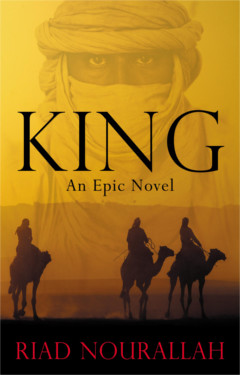 To sum up, this is a book which tempts the reader to go back to it time and again, a source for simple wisdom and an exemplum of endurance and triumph over adversity, a tribute to two Brechtian ‘Mothers Courage’ who never allow hard times to harden their hearts as they go about doing their daily chores while the firing squads and fanatics of the world do their own. Thanks to this memoir, the old ladies will continue to be remembered, industrious and indomitable as they must have been in reality. Even with their tiny garden, meagre attic, and severe self-denial, they will continue to embody the human spirit and act as agents of life and of its untiring expansion. And they will go on to radiate the creativity, beauty, and sustaining power and struggle of their fellow women in the Middle East and women everywhere.
Riad Nourallah, MA (AUB), PhD (Cantab.)
Director of Research, London Academy of Diplomacy, and author of KING
[1] See for instance Hazza M. Abu Rabia (2011), Al-Nasirah al-‘Uthmaniyyah fi ‘Uun Gharbiyyah [Ottoman Nazareth in Western Eyes ]. Nazareth: Al-Hakim Printing and Publishing; M. Yazbak and S. Sharif, eds. (2013). Nazareth: History and Cultural Heritage. Nazareth Academic Studies Series No. 2: Nazareth Municipality of Nazareth.
[2] See, for instance, Nur Masalha (2009). 60 Years after the Nakba: Historical truth, collective memory and ethical obligations. Kyoto Bulletin of Islamic Area Studies, 3-1: 37-88; Mari Oka (2009). Narrating and listening to the memories of Nakba in Kyoto: Dialogue between Palestine and East Asia. Idem. 170-175; Sari Hanafi (2009). Haifa and its refugees: The remembered, the forgotten and the repressed. Idem. 176-191. Also see Fatma Kassem (2011). Palestinian Women: Narrative histories and gendered memory. London: Zed Books.
[3] The reference is to the Masculinity vs. Femininity Index in Hofstede’s Cultural Dimensions theory. See Arab World, ITIM International, at www.geert-hofstede.com/hofstede_arab_world.shtml. For the classic study, see G.H. Hofstede (1984). Culture’s Consequences: International differences in work-related values. London: Sage. But also see Galit Ailon (2008). Mirror, mirror on the wall: Culture’s Consequences in a value test of its own design. Academy of Management Review. 33 (4): 885-904.
Photos from the launch of The White Umbrella by Brian Sewell


We were delighted to launch The White Umbrella by Brian Sewell earlier this month. It was a fantastic evening at Fortnum & Mason. Get your copy of the book here today!
The TLS reviews A Woman’s Story by Annie Ernaux
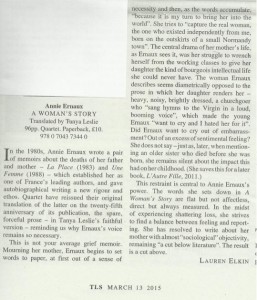
‘She has resolved to write about her mother with almost “sociological” objectivity, remaining a “cut below literature”. The result is a cut above’
The TLS reviews A Woman’s Story by Annie Ernaux. Get your copy of the book here today!
Hummingbirds in My Hair by Pamela O’Cuneen is reviewed in the European Direct Magazine
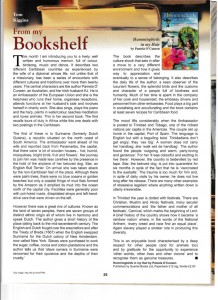 Hummingbirds in My Hair by Pamela O’Cuneen is reviewed in the European Direct Magazine.
Get your copy of the book here today!
The Mail on Sunday interviews Brian Sewell
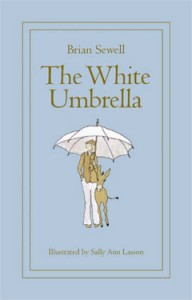
‘It’s a lovely, wistful story by a man famous for being magnificently rude, but a heart attack and cancer have changed Sewell.’
The White Umbrella by Brian Sewell is available now. Get your copy here today!
The Bookbag on The Girl from the Paradise Ballroom by Alison Love
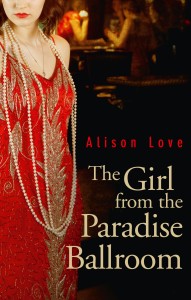
‘This character-driven novel of love and fear in wartime London is beautifully, subtly and skilfully written and will appeal to many types of reader.’
The Bookbag reviews The Girl from the Paradise Ballroom by Alison Love. Get your copy of the book here today.
The Camden New Journal reviews Doctors Dissected by Martin Scurr and Jane Haynes

Last night we celebrated the launch at the Royal College of Physicians. It was a fantastic evening.
The Camden New Journal also published their review of Doctors Dissected. Get your copy of the book here today!
The Daily Mail publishes a second extract from Doctors Dissected
 ‘If there is anything positive to emerge from our personal difficulties, it is that, as a doctor, your understanding of patients is enormously improved by such experiences. And with that comes the compassion that informs your sense of vocation.’
The Daily Mail publishes a second extract from Doctors Dissected by Martin Scurr and Jane Haynes. Get your copy of the book here today!
The Observer reviews Doctors Dissected by Martin Scurr and Jane Haynes
‘But these are not questions I was expecting to have addressed in print, let alone with candour, informality, warmth and absence of taboo. This wonderfully readable and unusual book is not conventional in its approach, which is partly what makes it sympathetic. It is personal, conversational, unpredictable… It is fitting that a book that deplores a loss of personal connection between doctors and patients should make time to explore intimacy between its covers. And although this book is not as crude as a rallying cry, it leaves one wanting to be part of a crusade to win doctors more time to be everything they want – and need – to be.’
A fantastic review of Doctors Dissected by Martin Scurr and Jane Haynes in the Observer. Read the full article here and get your copy of the book here.
Pamela O’Cuneen on Suriname: The Mysterious Land of Seven Cultures for the Expat Telegraph
 ‘It was a country of contradictions – imported left-hand drive cars from America were driven on the left side of the road so that no one could see who was coming. Dogs ran free in the streets, while birds were kept carefully in cages and taken for walks. Sheep grazed on city intersections, except that they looked like goats. We christened them “shoats”. And we learned to be ready with a dozen diplomatic answers when we attended social functions and were asked, Don’t you love our beautiful Suriname?’
Pamela O’Cuneen on ‘Suriname: The Mysterious Land of Seven Cultures‘ for the Expat Telegraph. Get your copy of Hummingbirds in My Hair here!